AuditTrace Labs Data Forensics & System-State Preservation Labs

Preserve what changed. Reconstruct what happened.

AuditTrace Labs preserves meaningful system state and the evidence surrounding change, so important events can be reconstructed, compared, and reviewed later.

Lineage without surveillance.

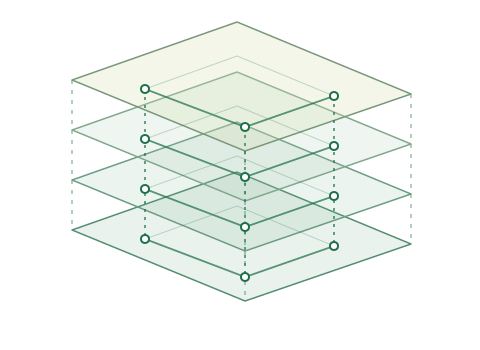
System state is layered. Configuration, relationships, artifacts, and the record of what changed each carry part of the answer — and they are rarely all still present when the question finally arrives.
The problem

Important evidence often disappears before the questions arrive.

Logs rotate. Systems change. Configurations are overwritten. Devices are replaced. People forget why something was done.

By the time an incident, dispute, remediation, or security finding needs to be revisited, the original context may already be fragmented.

AuditTrace Labs focuses on preserving that context while it can still be connected to the state it describes.

What we preserve

  • What the system looked like before
  • What changed
  • What remained afterward
  • What evidence supports the conclusion
  • Whether another reviewer can reconstruct the event later
The model

Preserve the transition, not just the artifact.

A meaningful event may be an incident, an authorized security test, a configuration change, a software deployment, a remediation, a hardware change, or another scoped transition.

  1. Pre-state

    The relevant condition of the system before the event, captured while it is still the current state.

  2. Meaningful event

    A scoped, authorized transition worth preserving — not everything that happens on a system.

  3. Post-state

    What the system looked like afterward, and what remained.

  4. Comparison

    The difference between the two states, recorded rather than remembered.

  5. Forensic context

    Chronology, provenance, acquisition conditions and documented limitations — the things that give a difference meaning.

  6. Human review

    A person reaches the conclusion. Software prepares the record; it does not decide what the record means.

The objective is to preserve what the system looked like before, what changed, what remained afterward, and the evidence needed to understand that change later.

Why the transition matters

A single artifact rarely answers the question. A packet capture shows network behavior. A configuration shows intended behavior. A log shows a recorded event. A disk artifact shows persistence.

The forensic question is how those pieces relate — and that relationship is usually visible only in the change between two states.

Scope is bounded and authorized

Preservation is scoped around meaningful, authorized events. More collection is not automatically better evidence.

Two disciplines, one record

Evidence needs context. A finding needs a reconstructable state.

Review later

Built for questions that do not arrive immediately.

AuditTrace Labs researches methods for preserving evidence and system context beyond the immediate response window.

A major design objective is supporting meaningful reconstruction more than 90 days after an event, when the available source material and the chosen retention scope make that possible.

We do not claim that missing evidence can be recreated, and we do not promise that every event remains reconstructable. We design so that important evidence stays understandable after the moment has passed.

  • Design goal
  • Subject to available evidence
  • Subject to retention scope
  • Not a guarantee
Evidence integrity

Integrity is more than a hash.

Hashes, timestamps, manifests, acquisition context, configuration state, comparison records, and documented limitations can all contribute to evidence integrity.

A checksum can help show that a file did not change. It does not explain why the file matters, where it came from, or what the system was doing at the time. AuditTrace Labs preserves the context around the evidence as well as the evidence itself.

What gives an artifact meaning

  • Acquisition context and conditions
  • Provenance and chronology
  • Surrounding system state
  • Manifests and comparison records
  • Documented limitations and gaps

We distinguish observed fact, derived conclusion, uncertainty, and missing evidence.

Working with AuditTrace Labs

A professional engagement path, and a path for matters that fall below the usual threshold.

Both exist deliberately. Neither is a substitute for the other.

Research laboratory

Tested against real system change.

AuditTrace Labs maintains a controlled laboratory environment for research involving system state, networking, storage, hardware, firmware, forensic workflows, and authorized security validation.

Laboratory work supports reproducible state transitions, evidence capture, recovery review, and better preservation methods. Research is how we evaluate what evidence is actually necessary to reconstruct meaningful change — and how long that evidence stays useful.

In development

Program & system design

AuditTrace Labs is developing a broader preservation and forensic-context program around system state, lineage, chronology, human review, and long-horizon reconstruction.

The program remains in active development. Public information is intentionally high-level while architecture and validation work continue.

Human authority

Lineage without surveillance.

AuditTrace Labs is designed around meaningful, authorized events — not indiscriminate collection.

Software and AI may organize evidence, compare state, identify relationships, surface discrepancies, or recommend additional context. Human authority remains the final gate for scope and for any consequential conclusion.

What this means in practice

  • Bounded, explicitly scoped collection
  • User-authorized context
  • Evidence gathered around meaningful change
  • Human-gated review and approval

What AuditTrace Labs is not

  • Continuous employee monitoring
  • Person or behavior scoring
  • Always-on endpoint surveillance
  • Indiscriminate data collection

Discuss a matter with AuditTrace Labs

Tell us what happened and what you need to understand. The initial inquiry is deliberately brief — please do not send credentials or sensitive evidence through it.